
Transaction Monitoring
How a Top-Tier US Bank Automated 78% of Transaction Monitoring Alerts
A large U.S. bank reduced false positives, accelerated investigations, and modernised its AML programme by deploying Arva’s intelligent Transaction Monitoring engine built on behavioural analytics, enriched alerts, and automated risk prioritisation.

type
Transaction Monitoring
date
A large U.S. bank partnered with Arva AI to streamline and automate its transaction-monitoring (TM) alert handling.
The bank’s legacy TM system (rules-based) was generating thousands of alerts per day—most low-risk, repetitive, or already explainable. This created operational bottlenecks, analyst fatigue, and rising backlogs.
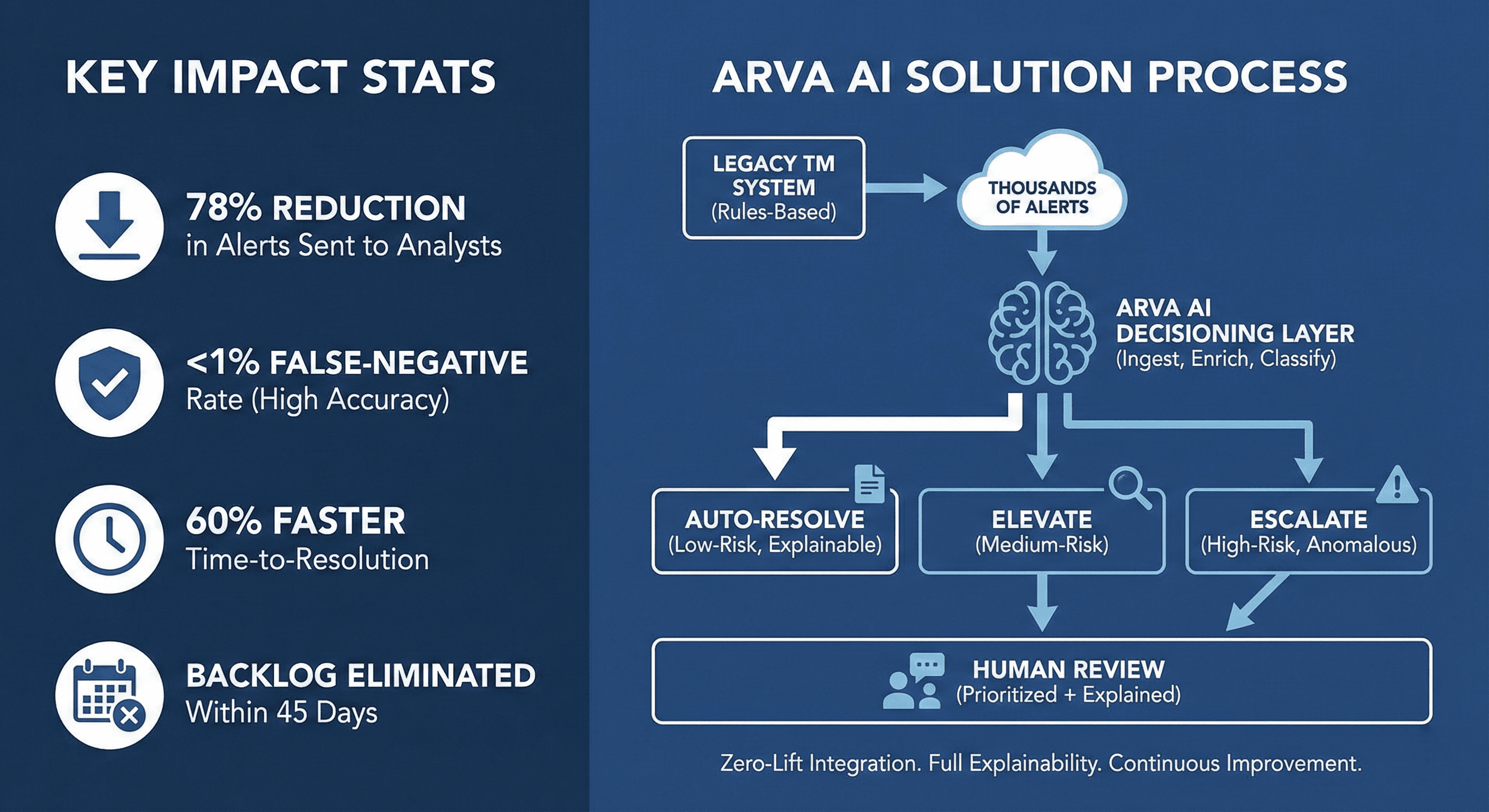
Arva did not replace the TM system. Instead, it became the AI decisioning layer that sits between alert generation and human review—classifying, enriching, and auto-resolving low-risk alerts with high accuracy.
Challenges
Excessive volume of TM alerts driven by static rule thresholds
Low analyst throughput and growing backlog
Repetitive alerts that consumed significant manual time
Rising regulatory expectations for explainability and risk-based decisioning
Desire to improve quality and reduce operating cost without modifying existing TM rules
Arva AI Solution
Arva deployed its TM Alert Automation Engine, which:
Ingests alerts directly from the bank’s TM system (no rules change required)
Enriches each alert with customer profile, risk score, historical behaviour, network relationships, and external intelligence
Applies a risk-based AI model to classify alerts as:
Auto-Resolve (low-risk, explainable, historically consistent)
Elevate (medium-risk)
Escalate (high-risk or anomalous patterns)
Generates full audit explanations for every decision to satisfy internal governance and regulator scrutiny
Pushes prioritised alerts + explanations into the bank’s existing investigation workflow
Integration
Completed zero-lift + data-mapping integration within 1 week
Parallel testing + model calibration completed in week 3
No core TM rules, core banking systems, or transaction schemas needed to change
Impact
After going live across all key products:
78% Reduction in Alerts Sent to Human Analysts: Arva auto-resolved the majority of routine alerts (e.g., expected behaviour, internal transfers, consistent peer-group patterns).
<1% False-Negative Rate: All high-risk or anomalous alerts were escalated to humans, validated through a 90-day quality-assurance period.
60% Faster Time-to-Resolution: Analysts spent time only on genuinely suspicious cases, supported by enriched context and ranked-priority queues.
Backlog Eliminated Within 45 Days: Automation and risk-based prioritisation removed aging queues entirely.
Full Explainability & Audit Trail: Every AI decision included a regulator-ready explanation, aiding the bank’s model-risk, AML, and internal audit teams.
Why the Bank Chose Arva
No need to touch or re-write existing rules
Fast integration with no lift required
High accuracy + audit-ready explainability
Continuous improvement loop (analyst feedback retrains the model)
Significant cost savings from workload reduction
Next Steps
The bank is now expanding Arva to automate adjacent processes:
Case narrative drafting
Network-based risk scoring
Cross-product behaviour detection
Suspicious activity report (SAR) enrichment